
Last updated September 22, 2026
Free on-site gate assessment - hinges, posts, and your LiftMaster or Nice gate operator checked before anything is quoted
The assessment is free and the quote is the invoice.


 Before
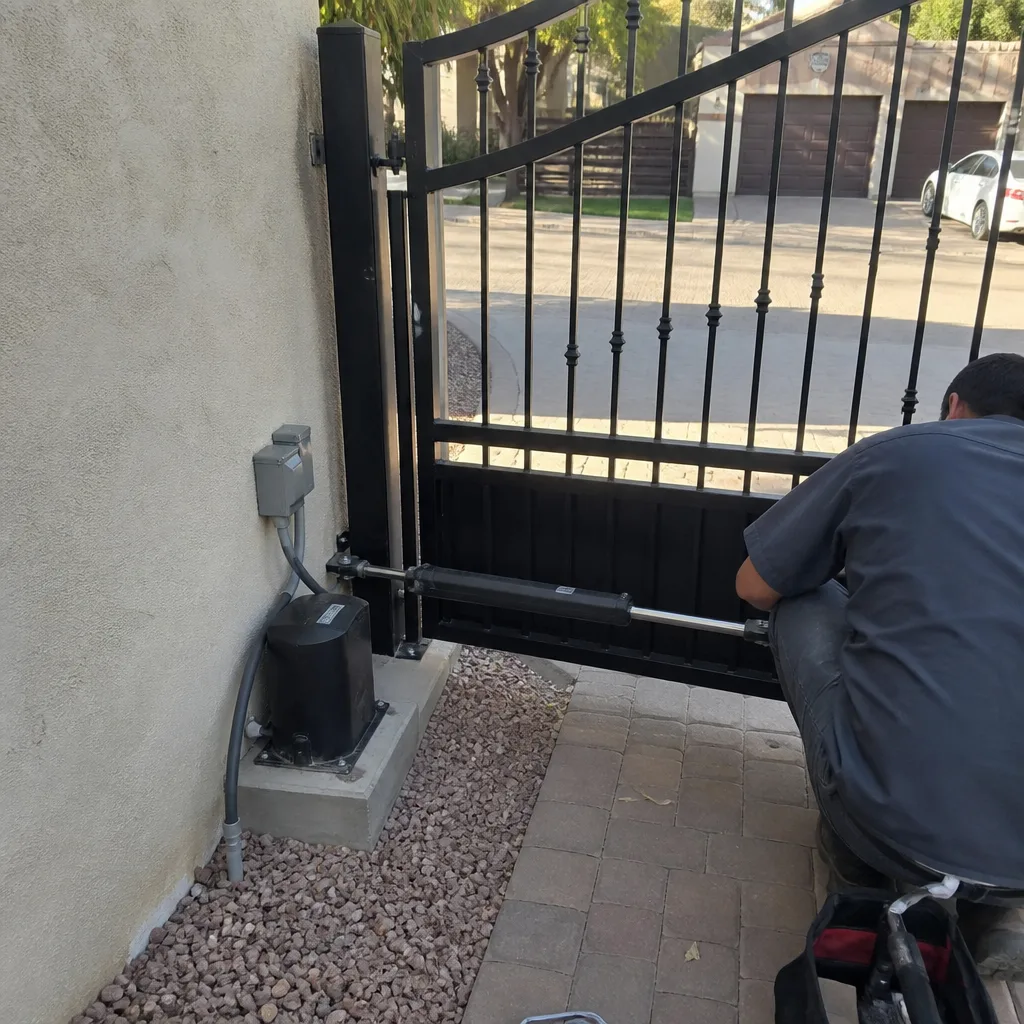 After
After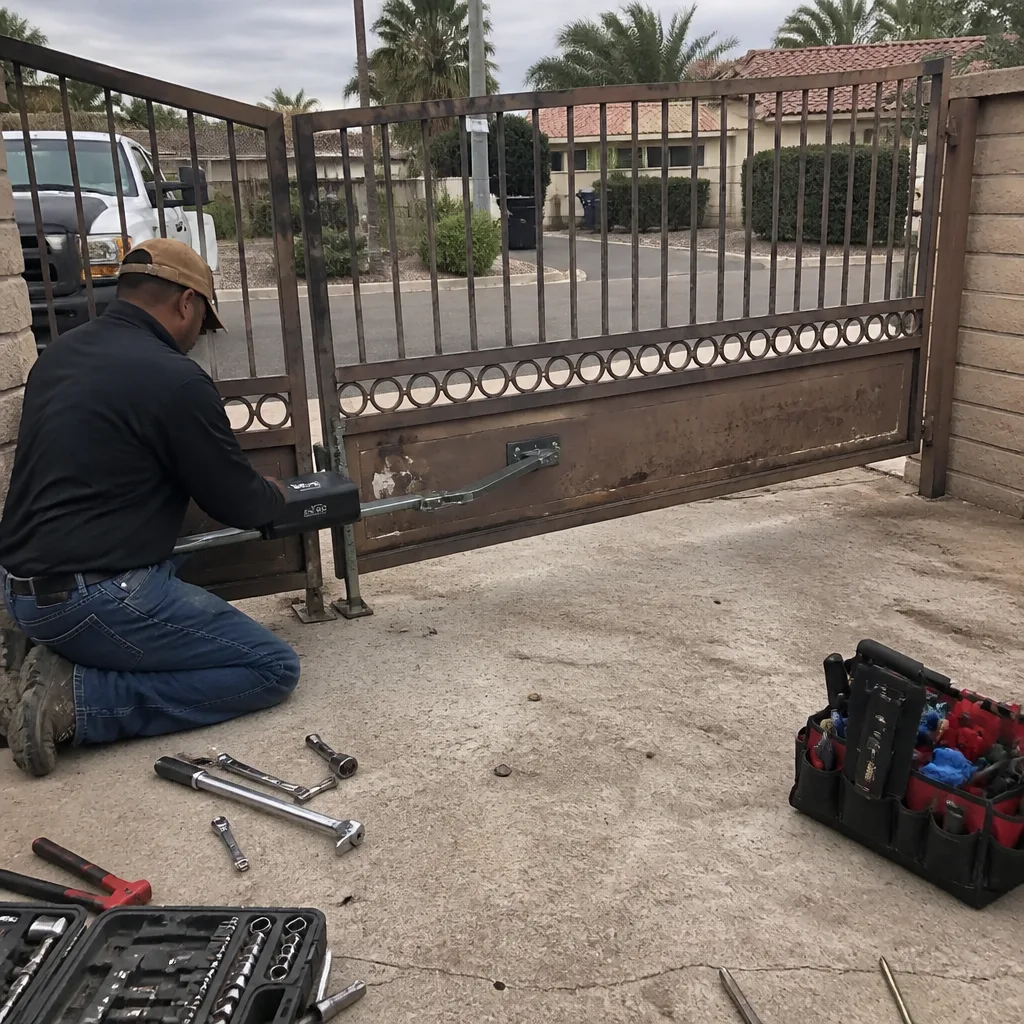 Before
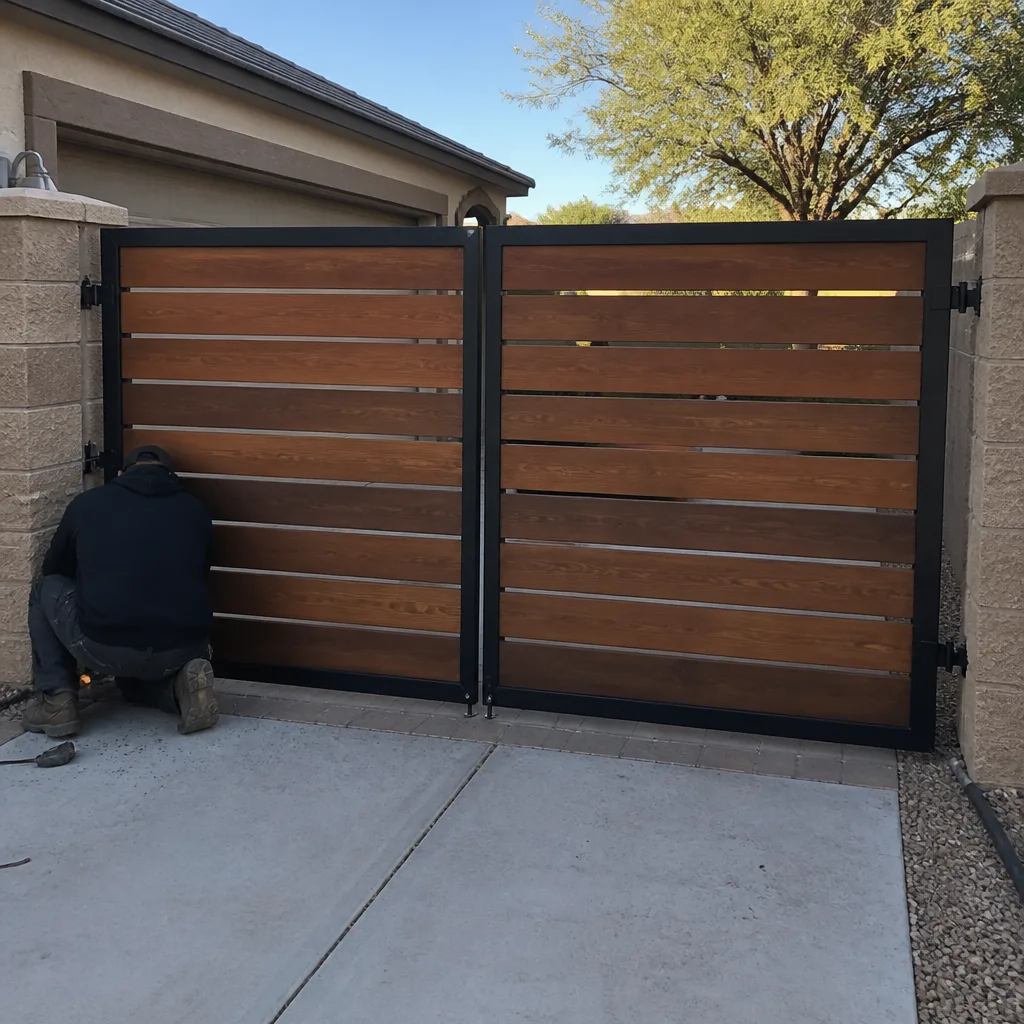 After
After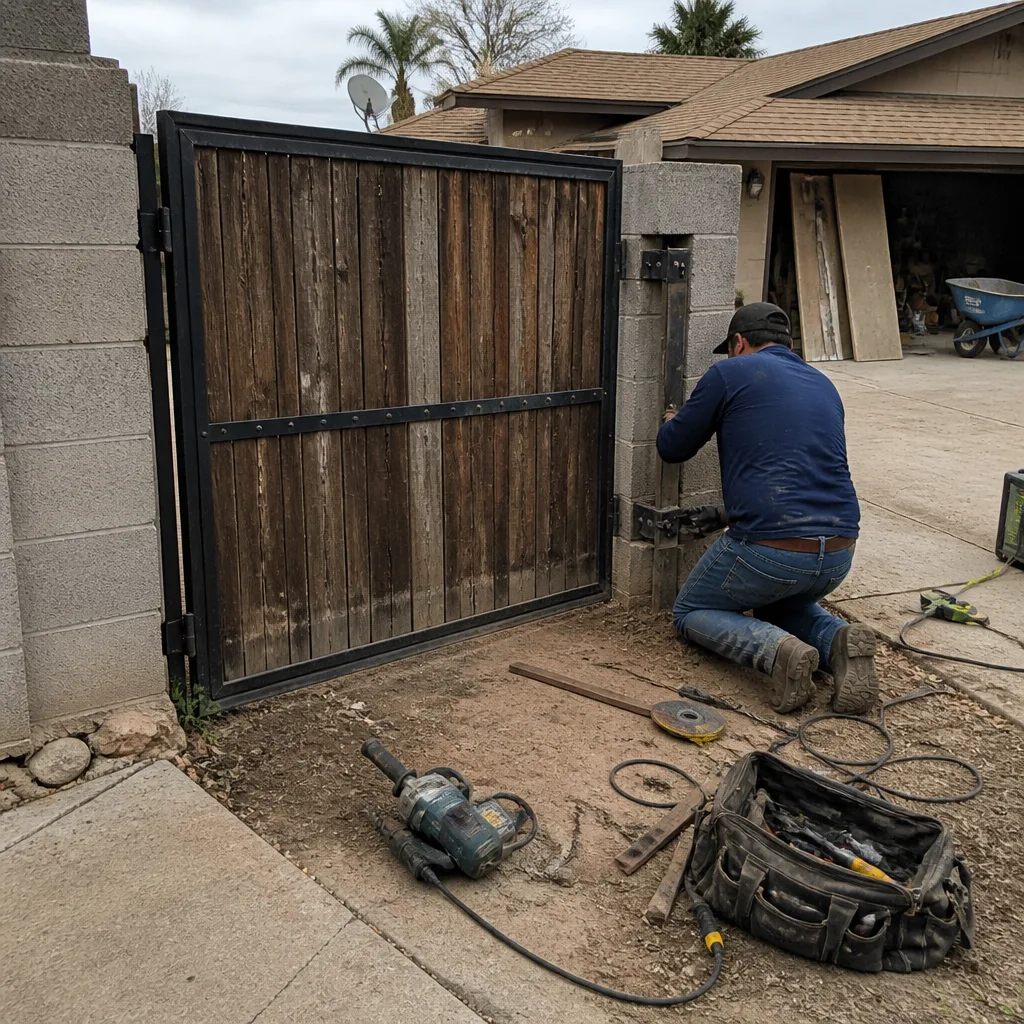 Before
 After
AfterGate Repair Maintenance Checklist for Phoenix Homeowners
The single most commonly skipped maintenance item on Phoenix driveway gates is checking limit-switch travel after summer, and it’s the one item that, ignored, turns a $90 adjustment into a $600 control board replacement. In our experience across 22,000+ gates since 2014, Phoenix’s UV exposure and monsoon moisture create a failure sequence unlike anywhere else: nylon drive gears degrade before metal shows fatigue, and electrical corrosion concentrates in a six-week window most homeowners miss entirely. This guide sequences every task by actual Phoenix failure probability, not alphabetical convenience, so you spend time where it prevents expensive damage. For professional help with any of these issues, see our Gate Repair services.
Quick Answer
A proper gate maintenance checklist for Phoenix homeowners includes monthly visual inspections during monsoon season (July-September), quarterly lubrication with high-temperature-rated products, semi-annual limit-switch travel verification after peak heat, and annual ground-connection testing before winter. Document every measurement with photos so drift becomes visible before it becomes damage.
Table of Contents
- Why Phoenix Gates Fail Differently: The Desert Failure Sequence
- Monthly Tasks: Monsoon Season (July-September)
- Quarterly Tasks: Surviving Peak Heat (May-June, September-October)
- Semi-Annual Tasks: Post-Summer Recovery and Pre-Winter Prep
- Annual Tasks: Establishing Baseline Measurements
- Phoenix Lubrication Guide: What Survives 120°F and What Doesn’t
- The Documentation System: Creating a Usable History
- Common Mistakes to Avoid
- When to Call a Professional
- Frequently Asked Questions
 Before
 After
AfterWhy Phoenix Gates Fail Differently: The Desert Failure Sequence
Gates in Phoenix don’t wear out the way gates in temperate climates do. The failure sequence is inverted, and most generic checklists miss it entirely.
Here’s what we’ve documented across thousands of gate repair calls in Phoenix:
- UV degradation strikes plastics and polymers first. Nylon drive gears, photo-eye housings, and wire insulation harden and crack while the metal components still look fine. A gear that meshed smoothly in March can strip teeth by September.
- Thermal cycling stresses solder joints and capacitors. Control boards experience 40-50°F daily temperature swings. Over three Phoenix summers, that’s roughly 1,000 stress cycles on every electrical connection.
- Monsoon moisture finds the cracks UV created. The six-week window from mid-July through August pushes humidity from 15% to 60% repeatedly. Water enters through compromised insulation, sits in conduit low points, and corrodes ground connections that were dry and stable in June.
- Metal fatigue accelerates only after the electrical and polymer systems have weakened. By the time a hinge pin shows wear, the control board may already be throwing phantom obstruction errors because moisture has compromised the safety circuit.
This sequence matters because it determines where your maintenance time goes. Checking hinge grease in March while ignoring photo-eye alignment is backward for Phoenix. The checklist below follows the actual failure probability.
Neighborhoods like Arcadia, Paradise Valley Village, and North Scottsdale see this pattern intensified. Larger properties mean longer cable runs, more underground conduit, and greater exposure to thermal expansion. In Ahwatukee Foothills, the steeper grades add mechanical load that combines with heat stress in ways flat-land gates don’t experience.
Monthly Tasks: Monsoon Season (July-September)
Monsoon season is when Phoenix gates experience their highest electrical failure rate. The humidity spikes are brief but violent, and they exploit vulnerabilities created during the preceding dry months.
Photo-eye alignment and housing integrity
Check both photo-eyes (the infrared beam sensors that stop the gate if something crosses the path). Look for:
- Cracked or yellowed lens housings. UV damage from May and June becomes a moisture entry point in July.
- Alignment drift. The LED indicator on most units (LiftMaster, DoorKing, Elite) should show solid, not flickering. A flicker means the beam is partially blocked or the emitter has weakened.
- Mounting bracket movement. Thermal expansion loosens brackets; monsoon winds finish the job.
Document the alignment with your phone: photo from the side showing beam path, photo of the LED indicator. If the bracket moved, measure the gap with a tape measure and record it.
Conduit and junction box inspection
Walk the full cable path from control box to gate. Look for:
- Standing water in junction boxes or conduit low points
- Green or white corrosion on wire nuts and terminal strips
- Conduit separations at expansion joints, common where underground runs cross driveway cuts
If you find moisture, don’t just dry it. Trace the entry point. In Phoenix, the most common entry is through expansion-joint separation where summer heat pulled PVC apart, then monsoon rain followed the gap.
Ground connection visual check
The ground rod and clamp at the control box should show no rust, no green copper corrosion, and no looseness. In monsoon season, a compromised ground creates erratic behavior: gates that stop mid-travel, keypads that work intermittently, or operators that throw “overload” errors with no mechanical obstruction.
We’ll cover how to test this without specialized tools in the annual section below.
Quarterly Tasks: Surviving Peak Heat (May-June, September-October)
These are the months when thermal stress peaks. The tasks focus on components that heat degrades before monsoon moisture ever arrives.
Limit-switch travel verification
This is the $90-versus-$600 item from our opening. The limit switch tells the gate motor when to stop opening and when to stop closing. In Phoenix heat, the mechanical limit switches on swing gates and the magnetic/electronic limits on slide gates both drift.
On a swing gate with mechanical limits:
- Run the gate through a full open-close cycle. Time it with your phone.
- Watch where it stops in both directions. It should reach the physical stop with no slamming and no premature stopping.
- Check the limit switch arm or cam. On Elite and Mighty Mule operators, the cam can shift on its shaft from thermal expansion of the operator housing.
- If the gate slams the stop or stops short, the limit needs adjustment. Record the current setting before changing anything.
On a slide gate with electronic limits (common on gate motor and opener systems in Phoenix like FAAC, BFT, and newer LiftMaster units):
- Run a full cycle and mark the stop positions with tape on the track or post.
- Check the operator display for any error codes. Many units log “overload” or “obstruction” events that indicate the motor is working harder than designed, often because limits are set too far and the gate is pushing against the stop.
- Record the limit settings from the menu if accessible.
Why this matters: when a gate slams its stop repeatedly, the motor draws excess current. The control board’s overload protection eventually fails, or the motor itself overheats and takes the board with it. We’ve replaced $600 control boards in Paradise Valley that needed only a 15-degree limit adjustment in June.
Battery load test (solar or battery-backup systems)
Phoenix heat cuts battery life by 30-50% compared to national averages. If your gate has solar panels or battery backup, test under load:
- Disconnect AC power and cycle the gate 3-5 times on battery alone.
- Count the cycles. A healthy battery should deliver at least 10 full cycles. If you get fewer than 5, the battery is near failure.
- Check battery case for swelling or terminal corrosion. Heat accelerates both.
Chain or belt tension
Thermal expansion changes tension. A chain that’s correctly tensioned at 70°F may be too tight at 110°F, increasing load on the motor and wear on sprockets. Check tension at the hottest part of the day, not morning. The chain should have 1/2-3/4 inch of sag at midpoint on a typical residential slide gate.
Semi-Annual Tasks: Post-Summer Recovery and Pre-Winter Prep
October and April are the pivot points in Phoenix. October ends thermal peak and monsoon risk; April precedes it.
Full hardware torque check
Thermal cycling loosens fasteners. Check and torque:
- Hinge bolts on swing gates (typically 3/8″ or 1/2″ bolts, 35-50 ft-lbs depending on gate weight)
- Track mounting bolts on slide gates
- Operator mounting bolts to pad or post
- Chain or belt tensioner hardware
Use a torque wrench and record the values. If a bolt was loose, note which one and how many turns it took to reach torque. This becomes your early warning for a stripped thread or fatigued bracket.
Control board capacitor inspection
This requires opening the operator housing. If you’re not comfortable with this, it’s a professional task, but visual inspection is valuable. Look for:
- Bulging or leaking capacitors (the cylindrical components, usually blue or black)
- Discolored solder joints around heavy components
- Corrosion on terminal strips, especially lower ones where moisture collects
On commercial access-control sites, we started photographing board condition annually in 2014. The photo log often shows capacitor bulging six months before failure, letting us schedule replacement during routine service rather than emergency calls.
Greased component refresh
Remove old grease from hinge pins, rollers, and chain, then reapply with product rated for Phoenix conditions. See the lubrication section below for specifics.
Annual Tasks: Establishing Baseline Measurements
The most valuable maintenance action you can take is creating a documented baseline. Without it, every future technician starts from zero. With it, drift becomes visible before damage occurs.
Photographic baseline protocol
Take these photos in consistent lighting, from consistent angles, with your phone’s date stamp on:
- Full gate from inside and outside, closed position
- Full gate from inside and outside, open position
- Each hinge from the side, showing pin and bracket relationship
- Operator nameplate (model, serial, date code)
- Control board with cover off, showing component condition
- Photo-eye alignment from emitter side, showing receiver LED
- Ground rod and clamp at control box
- Any junction boxes along the cable run, lids off
Store these in a dated folder. Next year’s photos go in a new folder with the same angles. When a hinge pin has migrated 1/4 inch over two years, you’ll see it. When a capacitor bulges, you’ll see it. When a wire nut corrodes, you’ll see it.
Ground connection test without specialized tools
Ground faults are common in Phoenix after monsoon season, and they’re dangerous: erratic gate behavior, potential shock hazard, and control board damage. Here’s how to test without a ground resistance meter:
- Turn off power at the breaker, not just the operator switch.
- Remove the ground wire from the ground rod clamp.
- Clean the wire end and clamp with sandpaper or a wire brush until bright metal shows.
- Reconnect and tighten firmly. A loose ground is a failed ground.
- With power still off, use a multimeter on the lowest resistance setting (ohms) to measure between the ground wire at the control box and a known good ground, such as a metal water pipe or a ground on a nearby outlet. You’re looking for near-zero resistance, typically under 1 ohm. Higher readings indicate corrosion in the ground path.
- If you don’t have a multimeter, at minimum verify physical integrity: clean metal-to-metal contact, tight clamp, no corrosion, no splices in the ground wire.
In Phoenix, ground rods are often driven into caliche or decomposed granite that doesn’t conduct well. If your gate has erratic electrical behavior and the ground test shows high resistance, the ground system may need augmentation. This is not a DIY fix; improper grounding can create shock hazards.
Motor current draw baseline
If your operator has a diagnostic display (common on DoorKing, FAAC, and newer LiftMaster units), record the running current in amps during open and close cycles. A 10% increase over baseline indicates developing mechanical resistance: dry hinges, track misalignment, or chain tension issues. A 20% increase means stop and diagnose before the next cycle.
For operators without current display, a clamp meter on the power feed gives the same data. Record the value and the ambient temperature; current draw varies with heat load.
Phoenix Lubrication Guide: What Survives 120°F and What Doesn’t
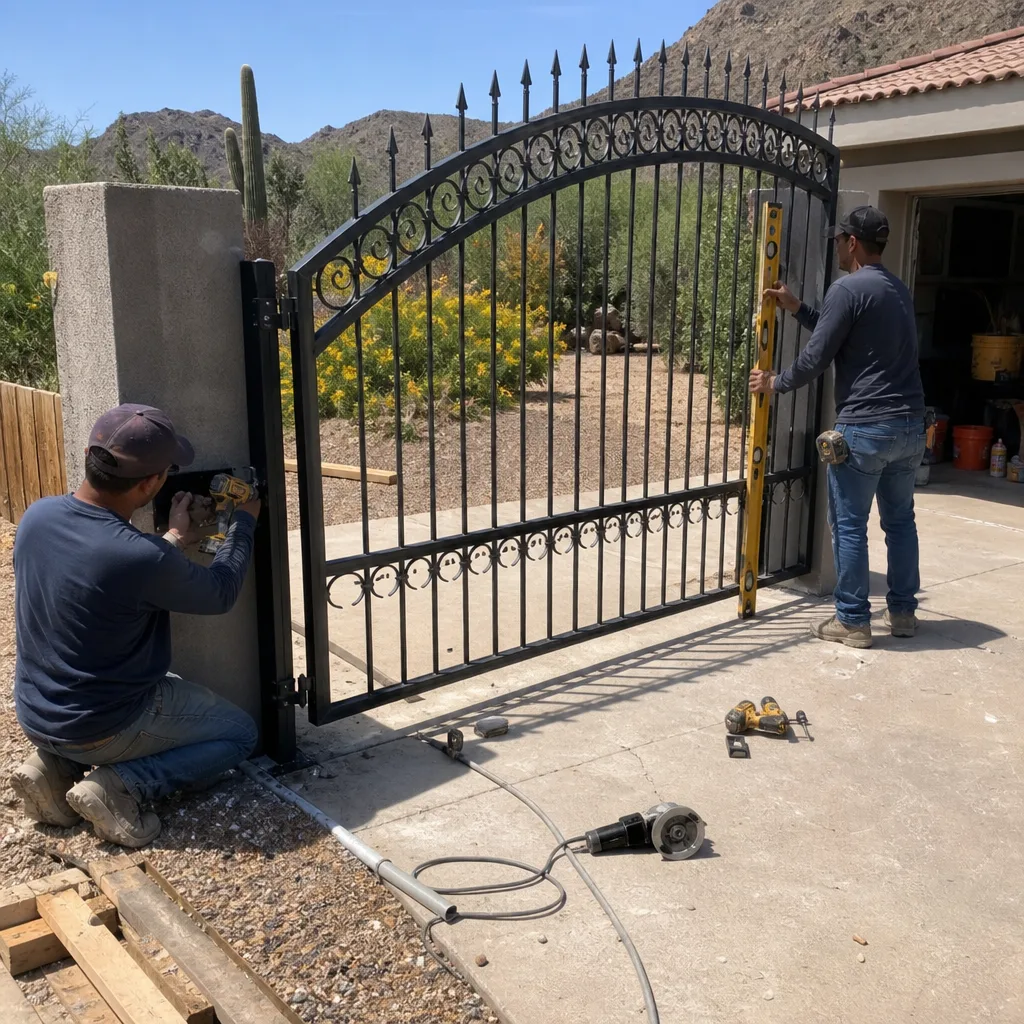
The wrong lubricant in Phoenix is worse than no lubricant. It carbonizes, attracts dust, or evaporates, leaving a sticky residue that accelerates wear.
Products that fail in Phoenix heat
- Standard lithium greases in tubes: separation above 110°F, oil bleeds out, thickener cakes
- WD-40 as a lubricant: it’s a water displacer, not a lubricant; evaporates in days
- General-purpose spray lubes with PTFE: the carrier evaporates, leaving insufficient film for metal-to-metal load
- Chain lubes designed for bicycles or motorcycles: formulated for moderate temps and frequent reapplication, not quarterly service in desert heat
Products that survive
- Chains and open gears: ISO VG 100 or 150 synthetic chain oil with tackifier. The tackifier keeps it from flinging off at chain speed, and synthetic base stocks resist oxidation at high temperature. We use this on commercial and residential slide gates across Phoenix.
- Hinge pins and bushings: Aluminum-complex or calcium-sulfonate grease with NLGI #2 consistency, rated for 350°F+ dropping point. These resist washout during monsoon season and don’t separate in August.
- Rollers and bearings: Polyurea-thickened grease, which has excellent mechanical stability and doesn’t harden with age. Critical for cantilever slide gates where roller seizure causes track damage.
- Stainless steel components: Anti-seize compound with nickel or copper base, not standard grease. Prevents galling where stainless contacts stainless or aluminum.
Application notes
Apply lubricant to clean metal. Wipe old grease off completely; don’t just add new on top of contaminated old. In Phoenix, dust infiltration is constant, and grease loaded with grit becomes grinding compound.
For chain-driven slide gates, lubricate the inner link plates and rollers, not the outer surfaces. Excess external grease collects dust and forms an abrasive paste. Run the gate through two cycles after lubrication to distribute, then wipe the chain exterior clean.
Frequency: quarterly for exposed chains and hinges, semi-annual for enclosed gearboxes (check manufacturer spec; most residential operators have sealed gearboxes that don’t need user service).
The Documentation System: Creating a Usable History
This is where Vance Gate Repair Phoenix differs from every other company we’ve encountered. Under The Haven Standard, every visit leaves a documented photo record of what was found, what was set, and what was installed. We developed this habit on commercial access-control sites starting in 2014, and we apply it to every residential gate we touch.
You can build the same system for your own maintenance. Here’s the minimum viable record:
Per-visit log entry
- Date and ambient temperature at time of service
- Gate cycle count from operator display (if available)
- Current draw: open / close, in amps
- Limit switch settings or physical stop positions
- Photo-eye alignment measurement (distance from reference point)
- Chain or belt tension measurement
- Lubrication products used and where applied
- Anomalies found and action taken
- Photos: hinge condition, board condition, ground connection, overall gate position
Why this matters for future service
When you call any technician with this record, the diagnosis time drops by half. More importantly, the technician can see trends. A motor current that rose from 3.2 to 4.1 amps over two years tells a story that a single 4.1-amp reading cannot. A hinge pin that migrated 1/8 inch annually for three years predicts failure in year four.
At Vance Gate Repair, when a homeowner brings us a maintenance log, we review it during our free estimate and often spot the developing issue before we unpack tools. Explore more guides & resources to build your maintenance knowledge. Under Clause 4 (Evidence on every job), we then add our visit to your record, with photos and measurements, so the next technician, whether us or someone else, has an even richer history.
We’ve seen this save homeowners in Arcadia and Paradise Valley thousands. One customer had five years of current-draw records showing gradual increase. We found a failing bearing in the gearbox that was still functional but approaching seizure. Replaced during scheduled service; no emergency call, no gate stuck open on a 115°F day, no security compromise.
Common Mistakes to Avoid
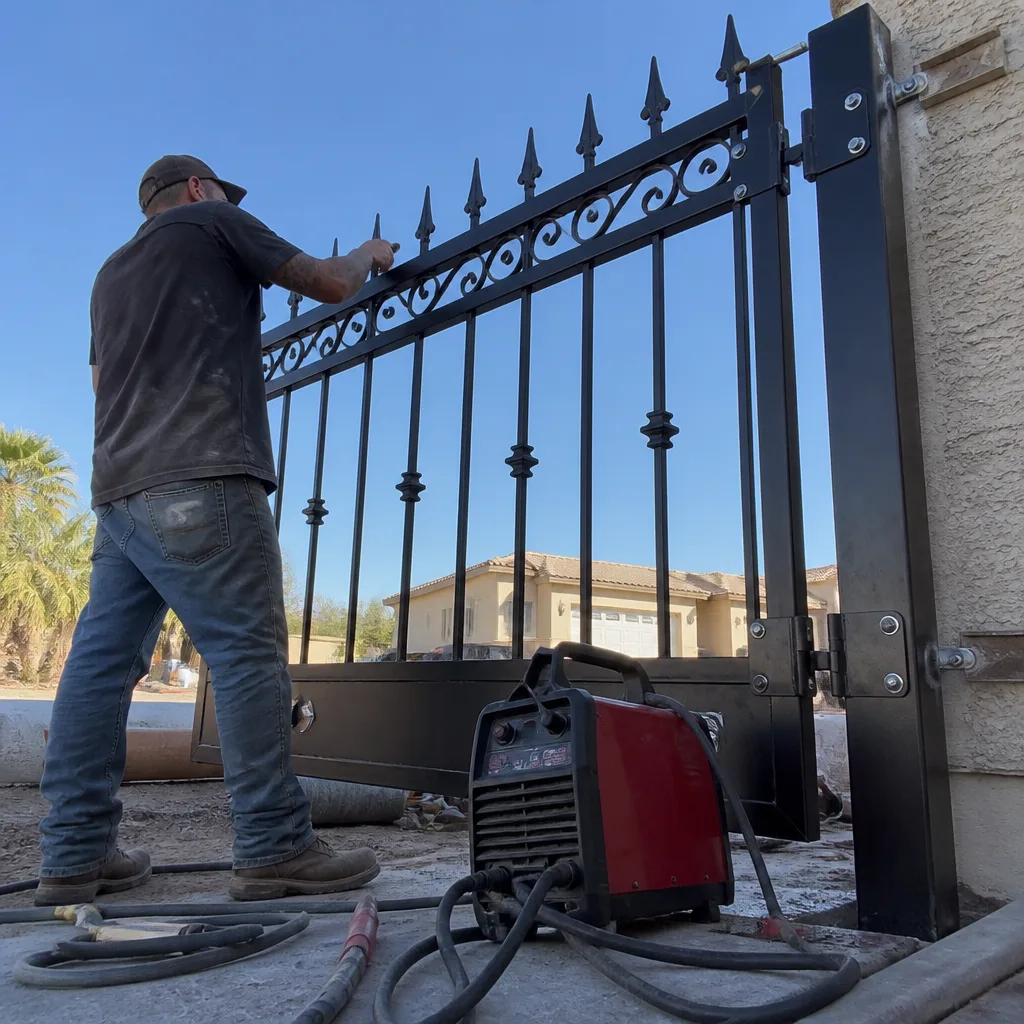
- Checking hardware in cool morning temperatures. Fasteners tightened at 75°F may be over-torqued at 115°F due to thermal expansion. Check at midday during peak season, or check twice and record both values.
- Using pressure washers on operators or control boxes. Monsoon cleanup tempts homeowners to blast dust off. Water forced into sealed housings at pressure destroys seals that dust alone would not penetrate. Wipe, don’t blast.
- Ignoring photo-eye flicker as “close enough.” A flickering LED means the beam is partially blocked. In Phoenix dust conditions, this worsens weekly. By the time the gate starts reversing randomly, the photo-eye housing may be heat-damaged beyond adjustment.
- Greasing without cleaning first. Grit-embedded grease is abrasive compound. We see hinge pins worn to half diameter in North Scottsdale because homeowners added grease annually without removing the black, sandy paste underneath.
- Skipping the annual ground test because “it worked last year.” Ground corrosion is invisible and progressive. In monsoon season, a compromised ground creates symptoms that mimic control board failure. Test annually; clean and tighten; document resistance if you can measure it.
- Adjusting limits without recording original settings. If your adjustment makes things worse, you need the original value to return to. We find limit switches set to extreme positions by homeowners who guessed, then couldn’t remember where they started.
- Assuming all operators use the same lubrication. Mighty Mule and Elite operators have different gearbox seals and temperature ratings than commercial FAAC or BFT units. Check the manual; use specified products. Generic “gate lube” from a hardware store often fails the temperature spec.
When to Call a Professional
Some maintenance tasks carry genuine safety risks and should not be attempted without training and proper equipment. Call a professional if you encounter any of the following:
- Control board capacitors that are bulging, leaking, or show burn marks. Capacitors can hold lethal charge even with power disconnected.
- Gate sag or hinge damage that requires removing a heavy gate from its posts. Residential driveway gates in Phoenix often weigh 300-800 pounds; improper support causes injury or property damage.
- Any electrical work beyond cleaning and tightening existing connections. This includes adding circuits, replacing operators, or modifying safety systems.
- Chain or belt replacement on tensioned systems. The stored energy in a tensioned chain can cause serious hand injury.
- Ground resistance readings above 5 ohms, or any sign of electrical shock from gate components.
- Erratic behavior that persists after you’ve completed the monthly and quarterly checks. This often indicates control board or motor issues requiring diagnostic equipment.
Vance Gate Repair Phoenix offers free estimates in Phoenix. Call (602) 483-6270, and we’ll review your maintenance log if you have one, inspect the gate, and provide a written scope and price before any work begins under Haven Standard Clause 1. Our technicians are background-checked and uniformed, with name and photo provided before arrival.
Frequently Asked Questions
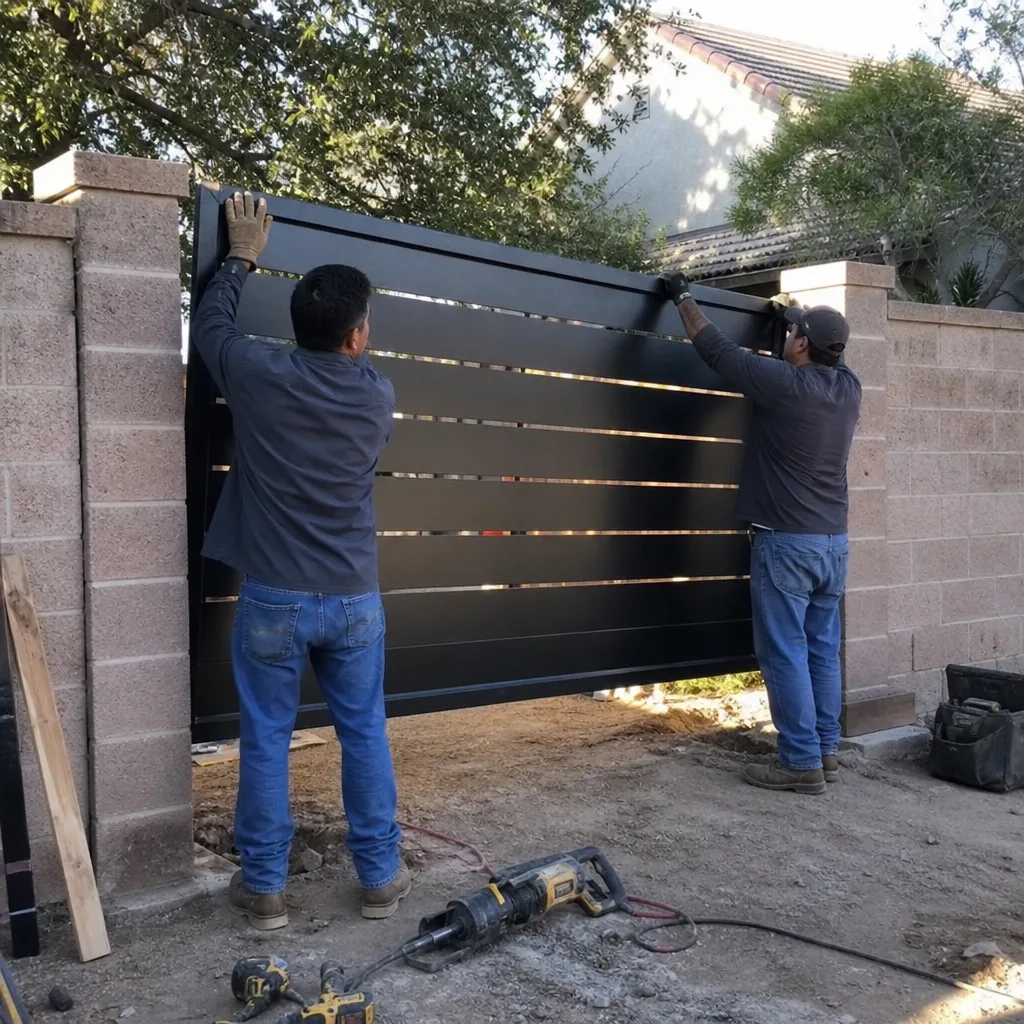
Professional gate maintenance in Phoenix typically runs $150-$300 for a single visit that includes full inspection, adjustment, lubrication with heat-rated products, and documentation. Annual service agreements, which include priority scheduling before monsoon season, generally range $400-$600 per year for residential gates. The exact price depends on gate type (swing versus slide), operator brand, and whether the gate has access-control components like keypads or telephone entry systems. Call (602) 483-6270 for a written quote specific to your gate - estimates are free.
Homeowners can safely perform monthly visual inspections, photo-eye cleaning and alignment checks, ground connection cleaning, and photographic documentation. Tasks involving electrical components under power, capacitor inspection, chain tension adjustment on loaded systems, or removal of heavy gates from hinges should be performed by trained technicians. In Phoenix, the combination of high voltage, extreme heat, and heavy gate mass creates risk levels that exceed typical homeowner maintenance scope. If you’re uncertain, Vance Gate Repair provides free estimates and can walk you through what’s safe to handle yourself versus what requires professional service.
Exposed chains and hinge pins need lubrication quarterly in Phoenix, due to dust infiltration and thermal degradation of lubricant film. Enclosed gearboxes typically need service only annually or per manufacturer specification, often 5,000-10,000 cycles. The critical factor is using lubricants rated for 350°F+ dropping point and synthetic base stocks that resist oxidation. Standard lithium greases available at hardware stores separate and fail within weeks of Phoenix summer heat. For specific product recommendations matched to your operator brand, call (602) 483-6270.
Thermal expansion changes mechanical tolerances, and heat increases electrical resistance in aging components. In Phoenix, the 40-50°F seasonal swing means a hinge pin that’s snug at 65°F may bind at 110°F. Control board capacitors lose capacity with heat; a marginally adequate capacitor in January fails in July. Photo-eye emitters weaken; the beam that reaches reliably in cool weather falls below receiver threshold in heat. The most common summer-specific failure we see is limit switch drift causing the gate to slam stops, which then overloads the motor and damages the board. Quarterly limit verification prevents this cascade.
Before July, verify photo-eye housing integrity, check all conduit and junction boxes for cracks or separations, clean and tighten ground connections, and test battery backup under load if equipped. During monsoon season, inspect monthly for moisture in boxes and alignment drift from wind. After the season ends, check again for corrosion that developed during humidity spikes. The pre-monsoon inspection is the highest-leverage maintenance window in Phoenix; problems found and fixed in June don’t become emergency calls in August.
Documented current draw is the clearest indicator. A motor drawing within 10% of baseline with smooth operation and no unusual noise typically needs only maintenance. A motor drawing 20%+ over baseline, running hot to touch, or making grinding or squealing noises is approaching failure. In Phoenix heat, motors work harder and fail faster than national averages. If your operator lacks current display, a technician with a clamp meter can measure this in minutes. Vance Gate Repair includes current draw measurement on every service call, documented in your job record under Clause 4.
The Bottom Line
Phoenix gate maintenance is not a generic checklist with “lubricate hinges” and “check batteries.” It’s a sequenced response to a specific failure pattern: UV damage first, thermal stress second, monsoon moisture third, mechanical wear last. Do monthly photo-eye and moisture checks from July through September. Verify limit-switch travel quarterly, at peak heat. Establish photographic and measurement baselines annually so drift becomes visible. Use lubricants rated for the actual temperatures your gate experiences, not the temperatures on the national product label. Document everything, because the technician who sees your history solves your problem faster and cheaper than the one starting from zero.
We’ve maintained and repaired 22,000+ gates since 2014, every one with a written price before work started and a documented record when we left. The Haven Standard exists because we believe homeowners deserve to know what they’re paying for and what was actually done. Apply the same standard to your own maintenance, and your gate will outlast the Phoenix summers that destroy neglected ones.
Written by Adrian Vance, Owner at Vance Gate Repair Phoenix, serving Phoenix since 2014.